Why Choose White Oak Engineered Hardwood Flooring Canada by Hilltop Forest
Published on
April 28th, 2026
Engineered Hardwood Flooring in Canada: Why White Oak Floors by Hilltop Forest Is the Best Choice?
Canadian homes are tough on flooring. The heating runs hard all winter, dropping indoor humidity to 20% or lower. In summer, it climbs back past 60%. That 40-point swing is enough to crack a solid hardwood floor within a few years. Most homeowners only find out after the damage is done.
Engineered hardwood flooring handles that cycle without any major concern. And when the species is white oak, the result is a floor that holds up to Canadian conditions while looking genuinely good.
This post breaks down exactly why engineered hardwood flooring in Canada makes sense, what sets white oak apart, and what the Hilltop Forest collection offers Canadian homeowners.
Why does most flooring fail in Canadian homes?
In a flooring store in Canada, you'll find plenty of products that look great. What you won't find is much honesty about how they perform when February hits, and your furnace has been running non-stop for two months. That's where most floors start failing.
The humidity problem no one warns you about
Canadian homes are dry in winter. When the heating runs hard, indoor humidity can drop to 20% or below. In summer, when you open windows, humid air pushes it back past 60%. That 40-point swing happens twice a year, every year. Wood absorbs and releases moisture with the seasons, and floors that can't handle that movement start showing it quickly.
What happens to solid hardwood over time here?
Solid hardwood flooring is a piece of timber. When it absorbs moisture, the whole plank expands. When it dries out, it shrinks back. Do that a few times, and boards start cupping at the edges; gaps open between planks, and the finish cracks where the wood has moved. None of that is a manufacturing defect. It's just what happens when solid wood goes through Canadian winters.
How is engineered hardwood built to handle it?
Engineered hardwood floors solve this problem with a cross-laminated Poplar core where each layer runs in a different grain direction. When one layer responds to humidity, the others resist it. According to the Hilltop Forest product specifications, this construction makes the plank up to 80% more dimensionally stable than solid hardwood. The white oak surface layer sits on top, looking exactly like solid wood, while the core below quietly does the structural work.
 Hardwood Flooring in Home
Why engineered hardwood flooring is the right choice for Canadian homes?
How does Canada's climate affect your floor every single year?
Most Canadian homes sit at around 20% relative humidity in winter and climb past 60% in summer. That gap is what does the damage. Any floor made from a single material expands and contracts with those swings. Over two or three years, the wear shows up as gaps, raised edges, or a finish that starts lifting at the seams.
Why does it work in basements when solid hardwood won't?
A lot of Canadian homes have finished basements used as a proper living space. Concrete slabs hold moisture, and the grade level means humidity sits higher down there year-round. Engineered hardwood floors, however, can be glued directly to a concrete slab or floated over an underlayment with a vapor barrier, making it a practical option for basement renovations where solid wood would fail within a season or two.
The growing shift toward engineered wood in Canadian home renovations
The Canadian flooring market is on track to reach $2.3 billion by 2030, with engineered wood accounting for a growing share of that. A lot of that growth is coming from Home Renovations rather than new builds. Homeowners updating older houses with concrete subfloors or adding living space below grade are choosing engineered hardwood because it fits more installations without the risk that comes with solid wood.
Why is white oak the best species for engineered hardwood floors?
There are plenty of species used in engineered hardwood flooring. White oak keeps coming up as the preferred choice because it genuinely performs better across the things that matter in a real home: hardness, appearance, finish compatibility, and responsible sourcing.
It's harder than most wood species used in flooring
White oak sits at 1360 lbf on the Janka hardness scale. That puts it above red oak, walnut, and most pine species commonly used in hardwood flooring. In practical terms, a harder surface dents less from furniture legs, resists scratching from daily foot traffic better, and holds up in kitchens and hallways where softer woods tend to show wear within a couple of years.
The grain naturally hides scratches and daily wear
The Hilltop Forest collection uses a wire-brushed finish on the white oak surface. The brushing process removes the softer wood fibers, leaving the harder grain slightly raised. That texture physically breaks up light reflection, so minor scratches and small dents disappear into the surface rather than catching the eye. In a busy household, that matters more than most people expect before they've actually lived on a floor.
It takes any stain evenly, light, dark, or natural
White oak has a tight, closed grain that absorbs stain consistently across the full plank. Red oak, by comparison, has a more open grain that tends to go patchy with certain finishes. With white oak engineered hardwood floors, whether the colour goes warm and natural, cool and whitewashed, or deep and dark, the result across each plank looks intentional rather than patchy.
It uses less timber and is responsibly sourced
Because the white oak is only needed for the 3.5mm wear layer, the rest of the plank uses Poplar for the core. Poplar grows faster and is used more efficiently than if the entire plank were solid white oak. All wood in the Hilltop Forest collection is legally sourced and documented, and the factory-applied finish is low-VOC (volatile organic compound), meeting standard formaldehyde emission requirements for indoor use.
What does the Hilltop Forest white oak collection offer?
The Hilltop Forest range isn't a single product with color options. It's two distinct collections built around different plank widths, each with its own color range, designed to suit different room sizes and installation scenarios.
Two collections, two plank widths, which one fits your space
The 18mm collection comes in a 7½" wide plank and covers 22.82 sq. ft. per box. The 15mm collection uses a narrower 5⅚" plank and covers 23.71 sq. ft. per box. Both share the same 3.5mm white oak wear layer and identical finish specs. The wider plank in the 18mm collection means fewer seams across the floor, which works particularly well in open-plan living areas. The 15mm suits smaller rooms or installations where a glue-down or nail-down method is preferred.
Why does the 3.5mm solid-sawn veneer matter?
Most entry-level engineered hardwood floors use a rotary-peeled veneer, which is cut in a continuous spiral and produces a less consistent grain. The Hilltop Forest collection uses a solid-sawn veneer, cut the same way as traditional solid hardwood planks. The result is a tight, straight grain that looks virtually identical to solid wood. At 3.5mm, it also allows one to two sanding over the life of the floor, which is more than most engineered products at this price point offer.
The finish that protects
The surface finish is a multi-coat urethane reinforced with aluminum oxide, applied at 10% sheen. That ultra-matte level means the floor doesn't reflect light like a lacquered surface (a surface that's hard and usually shiny). It looks like real wood with no plastic shine. The aluminum oxide reinforcement makes it one of the hardest factory-applied finishes available on white oak engineered hardwood flooring, with high scratch resistance in day-to-day use.
Hilltop Forest White Oak Collection Range
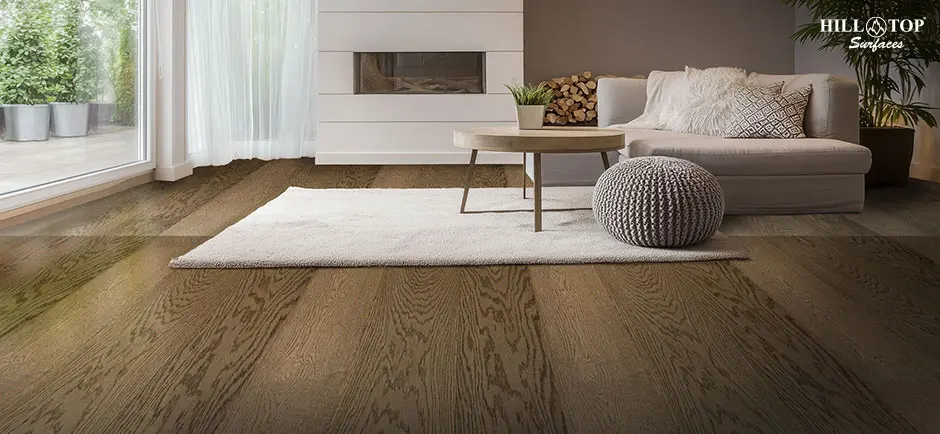 Roma Flooring
Roma Flooring
Roma flooring comes in both 15mm and 18mm thickness, with a 7½" wide plank and 22.82 sq. Ft. box coverage. The solid-sawn white oak engineered hardwood surface is wire-brushed and rated at 1360 Janka hardness. Roma flooring is a practical, wide-plank option for open living spaces that want a natural, low-sheen finish without the maintenance demands of solid wood.
Como Floring
Como is a solid-sawn white oak engineered hardwood flooring option available in both 15mm and 18mm thickness. With a Janka hardness of 1360 and a wire-brushed finish, it holds up well in high-traffic areas while keeping that natural, low-sheen look that suits most Canadian interiors.
Livorno Flooring
Livorno is a 7½" wide-plank white oak engineered hardwood flooring with a solid-sawn veneer and wire-brushed finish. At 1360 Janka hardness and 22.82 sq. ft. box coverage, it's a practical choice for larger rooms where fewer seams and a natural, low-sheen surface matter.
Milano Flooring
Milano flooring is a white oak engineered hardwood available in both 15mm and 18mm thickness, with a solid-sawn veneer and wire-brushed surface. The 1360 Janka hardness rating makes it a reliable pick for busy rooms. The ultra-matte finish keeps it looking like real wood rather than a factory product.
Niagra Flooring
Niagara flooring is the only Canadian-named color in the Hilltop Forest range, available in both 15mm and 18mm thickness. Built on a solid-sawn white oak engineered hardwood base with a wire-brushed finish and 1360 Janka hardness, Niagara Flooring suits homeowners who want a floor that performs through Canadian seasons without drawing attention to itself.
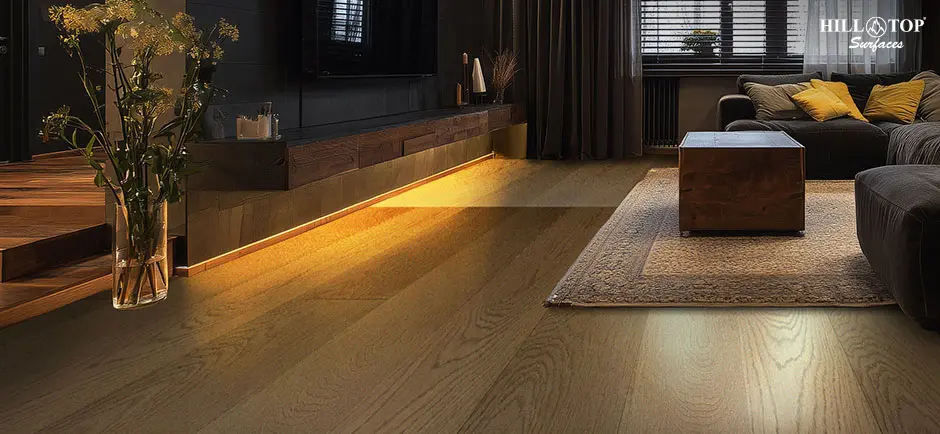 Verona Flooring
Verona Flooring
Verona Flooring is a solid-sawn white oak engineered hardwood available in both 15mm and 18mm thickness. The wire-brushed surface sits at 1360 Janka hardness, making it one of the hardest options in the Hilltop Forest range. A dependable choice for rooms that see regular foot traffic without wanting to show it.
How are Hilltop Forest engineered hardwood floors installed?
The Hilltop Forest collection supports three installation methods. Which one applies to your project depends on the subfloor type and grade level, not personal preference. Getting this decision right up front saves a lot of trouble later.
Nail-down
Nail-down works above grade and on grade only, on plywood or OSB (Oriented Strand Board) subfloors of adequate thickness. Appropriate cleats or staples designed for engineered hardwood are used to fasten each plank. It's a solid, traditional method that produces a floor with very little movement or flexes underfoot. It is not recommended for below-grade installs or anywhere a concrete slab is the base.
Glue-down
For concrete subfloors, glue-down is the preferred method. A premium urethane adhesive bonds the engineered hardwood floors directly to the slab. This method works at all grade levels, above, on, and below grade, and is also the recommended approach for installations over radiant in-floor heating systems. The direct bond reduces any hollow sound underfoot and keeps the plank flat against the subfloor consistently over time.
Floating
Floating works at all grade levels and is often the most accessible method for renovation projects. An approved underlayment with a vapor barrier goes down first, then tongue-and-groove joints between planks are glued together. No fasteners go into the subfloor at all. This makes it well-suited for basement conversions and concrete slab applications where nail-down simply isn't possible.
What to check before installation starts?
The subfloor needs to be clean, dry, structurally sound, and level before any plank goes down. Concrete subfloors should be fully cured and tested for moisture, with a moisture barrier applied if needed. The hardwood flooring itself needs a minimum of 48 to 72 hours to acclimate in the installation space, with the HVAC system running during that period to bring the planks to the room's actual temperature and humidity conditions.
How to keep your engineered hardwood floors in good shape?
Engineered hardwood floors are low maintenance, but they're not zero maintenance. The floors that still look good after ten years are usually the ones where a few small habits were kept up consistently.
Simple daily habits that protect the floor
Sweep or vacuum regularly on the hard floor setting. Spills go straight to a dry cloth before they sit. Felt pads under every furniture leg, doormats at every entrance. It sounds basic because it is but tracked-in grit is what slowly dulls a white oak surface more than anything else. These habits take about two minutes a day and add years to the floor.
What to avoid using prefinished hardwood?
The factory finishes on Hilltop Forest hardwood flooring is urethane reinforced with aluminum oxide. It does not need to wax and does not respond well to household cleaners not designed for wood. Vinegar, ammonia, steam mops, and abrasive products all damage the finish over time, either stripping it or forcing moisture into the wood beneath. Use a cleaner made for prefinished engineered hardwood flooring, damp mop only, and the finish holds up the way it's supposed to.
If you have pets, here is what to know
The wire-brushed surface on this floor was a deliberate choice, and it works well in pet households. When softer wood fibers are removed during the brushing process, the harder grain sits slightly raised. That texture catches and diffuses light, so minor scratches from pet nails blend in rather than stand out. The aluminum oxide finish adds a layer of abrasion resistance on top of that. Keep nails trimmed, and this floor handles pets without showing it.
How to clean hardwood floors?
Use a cleaner made specifically for prefinished hardwood floors. Damp mop only, wringing the mop out well before it touches the floor. The goal is barely damp, not wet. Water and wood don't get along, and even a few minutes of standing moisture works its way into the finish over time.
How to clean wood floors?
Sweep or vacuum first to lift the grit, then follow up with a cleaner made for wood floors and a well-wrung damp mop. The mop should feel almost dry before it touches the surface. Any moisture left sitting on hardwood flooring works into the finish and eventually into the wood itself, which is where the real damage starts.
How to clean engineered hardwood floors?
Engineered hardwood floors have a factory-applied finish that reacts badly to the wrong products. Stick to a cleaner labelled for prefinished hardwood, use a damp mop wrung out thoroughly, and work in the direction of the grain. Skip the steam mop entirely.
How do you fix squeaky floors?
Squeaky hardwood floors are usually a subfloor problem, not a flooring defect. For floating engineered hardwood, uneven underlayment is often the cause. The floor flexes when you step on it. For nail-down installs, loose fasteners are the usual culprit. Screws driven from below pull the floor back flat and stop the noise.
Conclusion
Canadian homes put floors through a lot. Dry winters, humid summers, concrete basements, and furnaces running for months straight. Most flooring isn't built for that. Engineered white oak is. The layered core handles the seasonal moisture changes, the 3.5mm wear layer looks just like solid wood, and the wire-brushed finish holds up to daily use without showing every scratch. The Hilltop Forest collection is made for real Canadian homes, not a climate-controlled showroom.
Most floors start showing damage after a few Canadian winters. Gaps, raised edges, a finish that lifts the seams. Engineered white oak from the Hilltop Forest collection is built to handle the humidity swings and concrete subfloors from day one. Browse the full range and find the right fit for your space.